Hayford Amedji-Dela Anyidoho
Indefinitpronomen –
What are Indefinitpronomen?
Indefinitpronomen (indefinite pronouns) are words that replace nouns without specifying exactly who or what you’re talking about. They are useful when you don’t want to repeat a noun or when the specific person or thing is not important.
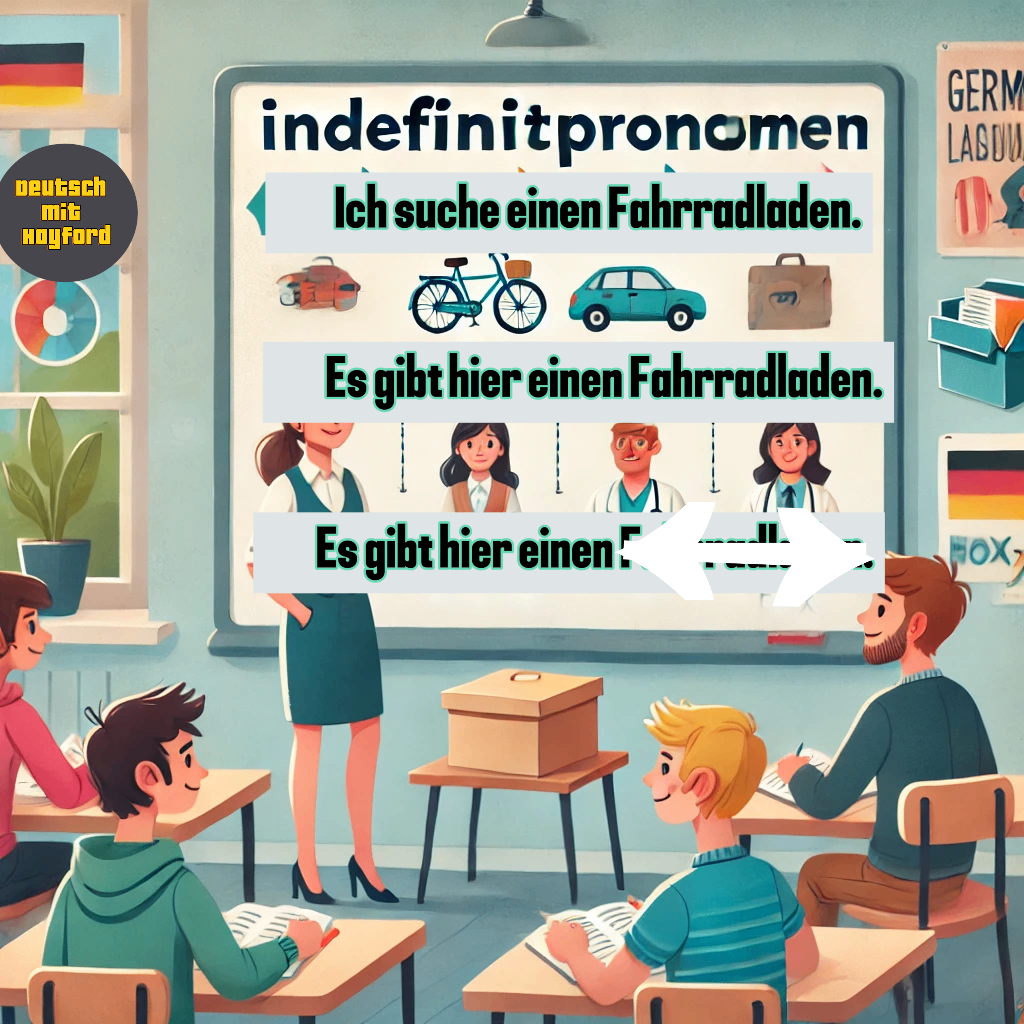
How They Work
Indefinitpronomen replace a noun that was already mentioned or is implied in the conversation. Let’s look at some examples:
- Einen (one):
- Example:
- Question: Wer kennt einen Fahrradladen?
(“Who knows a bike shop?”) - Answer: Ich suche einen.
(“I am looking for one.”)
- Question: Wer kennt einen Fahrradladen?
- Here, “einen” replaces “Fahrradladen” (bike shop).
- Example:
- Eine (one, feminine):
- Example:
- Question: Wer kann eine Kinderärztin empfehlen?
(“Who can recommend a pediatrician?”) - Answer: Wir brauchen eine.
(“We need one.”)
- Question: Wer kann eine Kinderärztin empfehlen?
- “Eine” replaces “Kinderärztin” (pediatrician).
- Example:
- Eins (one, neutral):
- Example:
- Question: Brauchst du ein Fahrrad?
(“Do you need a bike?”) - Answer: Ich habe eins.
(“I have one.”)
- Question: Brauchst du ein Fahrrad?
- “Eins” replaces “Fahrrad” (bike), which is a neutral noun in German.
- Example:
- Welche (some):
- Example:
- Question: Du willst — deutsche Leute kennenlernen?
(“Do you want to meet some German people?”) - Answer: Hier findest du welche.
(“Here, you’ll find some.”)
- Question: Du willst — deutsche Leute kennenlernen?
- “Welche” refers to “deutsche Leute” (German people).
- Example:
Key Points to Remember
- The form of the Indefinitpronomen depends on the gender (masculine, feminine, neutral) and case (nominative, accusative, etc.) of the noun it replaces.
- Masculine: einen (Accusative)
- Feminine: eine
- Neutral: eins
- Plural: welche (some)
- Indefinitpronomen avoid repetition in a conversation, making your speech clearer and less redundant.
 Ghana Association of Teachers of German - (GATG) Ghanaischer Deutschlehrerverband & Verein Deutsche Sprache in Ghana (VDS.e.V.)