Hayford Amedji-dela Anyidoho
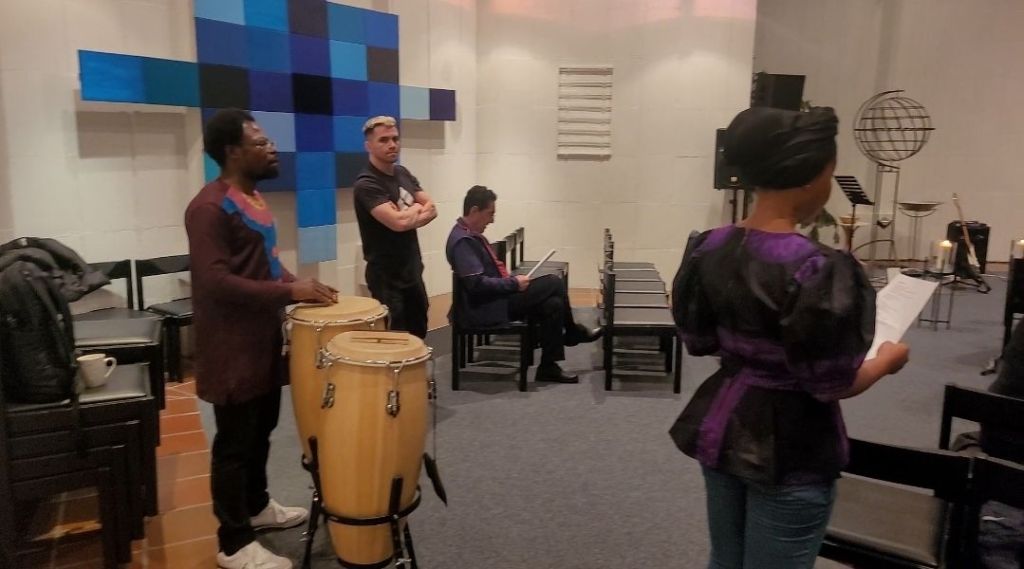
Learning a foreign language can be a daunting task, but studies show that a musical ear – the ability to recognize and interpret tones, rhythms, and melodies – is a valuable asset in language acquisition.
This connection between music and language skills has profound implications for both language teachers and learners.
Firstly, music is inherently a universal language, encompassing rhythm, pitch, and intonation – elements that also play a crucial role in spoken language.
A musical ear aids in recognizing and mimicking these aspects of a foreign language. Particularly, intonation, the musical quality in the voice when speaking, is critical for learning pronunciation and emphasis in a new language.
Furthermore, music enhances memory and concentration. Songs and melodies can be used as mnemonic devices to more easily remember vocabulary and grammatical structures.
Many language teachers already utilize music to support learning and make teaching more engaging.
Interestingly, studies have also shown that musical training strengthens neurological connections relevant to language processing and learning. Individuals who are musically trained often exhibit an increased ability to distinguish tones, which is particularly useful in learning tonal languages like Mandarin or Vietnamese.
So, what exactly are “Talking Drums”?
Talking drums are a fascinating phenomenon in the culture of West Africa, particularly in Ghana and Nigeria. These drums are not just musical instruments but also serve as a means of communication over long distances.
They uniquely mimic the intonation and rhythm of certain African languages, thus effectively “speaking”.
In Ghana and Nigeria, talking drums are primarily used in traditional ceremonies and festivals.
They play a central role in the musical landscape and are deeply rooted in the history and traditions of the respective cultures. The most renowned talking drums include the Yoruba drums from Nigeria, as well as the “Ewe Talking Drums” and “Akan Talking Drums” from Ghana.
The Ewe talking drums, such as “Atsimevu” and “Sogo”, are particularly noted for their deep, resonant sound quality. Like other talking drums in West Africa, they too mimic the tones and rhythms of the Ewe language.
In this context, a musical ear offers a fascinating and effective bridge to learning foreign languages. By recognizing and leveraging the parallels between music and language, we can enrich and facilitate the acquisition of languages.
Sources:
📸 Sieh dir dieses Video auf Facebook an
https://www.facebook.com/share/v/4tVJDRCTv6XUjKth/
Sprachentwicklung bei Kindern: Warum Musik dabei hilft
 Ghana Association of Teachers of German - (GATG) Ghanaischer Deutschlehrerverband & Verein Deutsche Sprache in Ghana (VDS.e.V.)